ABOUT
https://linktr.ee/judithnangalacrispin
Judith Nangala Crispin is an acclaimed poet, visual artist, motorcyclist, conservationist and volunteer firefighter, who lives on unceded Ngunnawal/Ngambri Country near Braidwood on the NSW Southern Tablelands. Her poetry has won the Blake Prize, been nominated for a Pushcart Prize, and been shortlisted for many awards including the Peter Porter Prize. Her visual art has won her residencies, awards, and wide acclaim, here and overseas.
Judith has published a collection of poetry, The Myrrh-Bearers (Sydney: Puncher & Wattmann, 2015), and a collection of photographs and poems made with the Warlpiri, The Lumen Seed (New York: Daylight Books, 2017). Her third, and most extensive book, The Dingo’s Noctuary, is available for pre-order here.
Judith spends part of each year living and working with the Warlpiri, her adopted people, in the Northern Tanami Desert. Her images and poems have been included in the Lunar Codex time-capsule which was deposited on the moon as part of the Blue Ghost mission in 2024. a proud member of Oculi collective and FNAWN (First Nations Australia Writers Network), and an Artist in residence with Music Viva.
Judith is a descendant of Bpangerang people from the Murray River and acknowledges heritage from Scotland, Ireland, France, Armenia, Mali, Senegal and the Ivory Coast. She does not speak for any Aboriginal groups, tribes or clans and claim no cultural authority. Judith chooses not to access grants or funding intended exclusively for Aboriginal people because of her relative privilege and identity as a mixed heritage person. For clarity, you can read more about her position in relation to Aboriginality here: Statement concerning Aboriginal Identity.
Judith has directed and worked on two major social justice research projects–The Julfa Project, which preserved photographic records of a destroyed Armenian cemetery and digitally reconstructed the site from new and existing images; and Kurdiji 1.0, an Aboriginal suicide prevention app, which strengthens resilience in young indigenous people by reconnecting them with community and culture.
Scroll down for information on her books, exhibitions and press reviews.
BOOKS
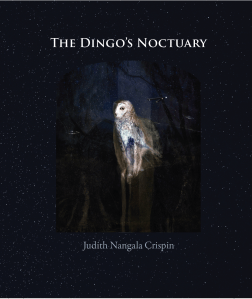
The Dingo’s Noctuary (Sydney: Puncher & Wattmann, 2025). Set against a backdrop of Australia’s central deserts, The Dingo’s Noctuary explores themes of identity, belonging, and the fragile threads that connect all living beings. At the heart of the tale is a soul’s dark night, the flight of a lady motorcyclist, in the prime of her invisibility, and her mongrel dingo Moon, into the Tanami desert. She’s searching for a caravan of miraculous dog-headed beings, glimpsed in dreams and the dementia tales of an old desert lady. The Dingo’s Noctuary is an illustrated verse novel, complete at 70,500 words. It includes accurate hand drawn maps of the Australian central deserts, pressings of rare plants, and forty-seven lumachrome glass prints, afterlife portraits of animals and birds. The story unfolds through combinations of poetry and prose, alongside visual images- maps of land and stars, plant pressings, and forty-seven afterlife portraits of animals and birds. It is a single-authored book in which the images and texts are equally weighted. The book was written over thirty-seven desert crossings, sometimes on the motorcycle with the dog on the back. The entire second half of the book was written on a typewriter after a motorcycle crash (the unsuccessful 37th crossing) left me unable to use a computer. I made a motorcycle blog about one of the journeys in this book here . Work from The Dingo’s Noctuary has received a number of awards and prizes including the 2023 Sunshine Coast Art Prize and the 2020 Blake Prize for Poetry. It was highly commended in the 2023 Mullins Conceptual Photography Prize and shortlisted for the 2023 Milburn Art Prize, the 2023 and 2025 Ravenswood Prizes for Australian Women’s Art, and the 2019 Olive Cotton Prize. Images and texts from this book were included in the Lunar Codex time-capsule which was deposited on the moon as part of the Blue Ghost mission in 2024. A mock-up of the complete book was shortlisted for the 2023 Arles Luma Recontres Dummy Book Prize.
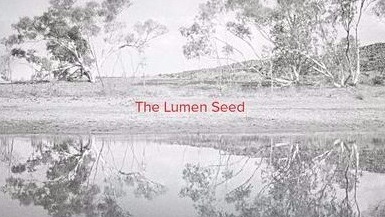
The Lumen Seed (NY: Daylight, 2017) contains photographs, drawings and poems about the indigenous Warlpiri people of Australia’s Northern Tanami Desert.
The Lumen Seed depicts a cultural dialogue taking place before a backdrop of offences against the Australian continent, as well as a history of systematic discrimination against indigenous peoples on the part of the country’s white population. The images, created in close consultation with Warlpiri people, document an attempt by elders to share sacred information with white people; the poems convey my interpretation of those ideas, alongside my slow development of personal relationships with community elders.
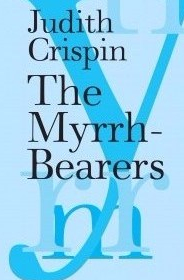
The Myrrh-Bearers (Sydney: Puncher & Wattmann, 2015) is a book of love poems, describing real events and real people as the poet has experienced them. The worlds evoked in these poems are suffused with faerie tales, myth and philosophy. The genesis of this collection lies in a diverse engagement with different poetries: the influence of the Polish poets Wisława Szymborska and Czesław Miłosz, along with that of the French poets Henri Michaux, René Char, René Daumal and Alfred Jarry; there is also the sure presence of Gwen Harwood and Judith Wright as well as, more esoterically, William Blake and G. I. Gurdjieff. The pataphysical influence of Jarry, in particular, leads to a poetry which attempts to describe a universe supplementary to the one which we inhabit. The presence of music as a subject stems from a close engagement with musical mentors, Larry Sitsky in Australia, Emmanuel Nunes in France and Karlheinz Stockhausen in Germany.
 Judith Nangala Crispin
[…] Crispin, poet and photographer, whose work, according to her web site, ‘includes themes of displacement and identity loss, a reflection of [her] own lost […]
LikeLike
deeply moved, deranged, weeping, thinking, dancing, contemplating, loving… thank you!
LikeLike